

A few years ago I went to a workshop on intuitive eating. The dietician and coach who ran the course explained the concept of mindful and intuitive eating, and discussed how healthcare providers can bring it into practice and everyday life. And it got something niggling in the back of my mind.
What does intuitive eating look like in the movement system?
Turns out it’s body trust. Embodied presence in your body. A sense of safety in the physical environment and good interoception. Letting all the signals your body and mind already notices and tracks actually land. Learning to listen to them, but not allowing them to flood and overflow your brain. And using them to make decisions about how you support your body and nervous system.
And at its heart, this is what good nervous system regulation is.
As we’re wrapping up this series on nervous system regulation, I’m hoping to connect the dots in this post. If you’re unsure of any of the earlier concepts, feel free to check out the posts from earlier in the series.
If you’ve followed this series from the beginning, I want to say something before we close: this is not easy material to sit with. Understanding your nervous system means looking honestly at how you’ve been surviving – and that can take some courage. The fact that you’re here, reading this, curious about your own inner landscape, already matters.
Nervous System Regulation
When you think about nervous system regulation, the first place that it matters is in controlling and buffering stress – both traumatic stress and chronic stress. Self-regulation really involves two things: helping you to engage better with people in the world, to have stronger relationships, and to better understand and respond to your emotions. And part of that means living from a set point in your body that you can consider your optimal state – what’s sometimes known as your ‘window of tolerance’.
As we’ve unpacked in earlier posts, polyvagal theory describes three main states: your safe and connected state (ventral vagal), your activated fight-or-flight state (sympathetic), and your energy conservation or shutdown state (dorsal vagal).
Your ventral vagal state is where you’re designed to live from. You’re able to focus, think clearly, and connect well with people – it’s the place where you feel well, settled, and at home in yourself. Your sympathetic and dorsal vagal states are survival states. They’re built into your body for good reason, and you need to be able to access them to respond well to genuinely challenging circumstances.
Think of your sympathetic state as pressing the accelerator. Your dorsal vagal state is pulling up the handbrake. Both have their place on the road – but neither should be the default. You can’t travel safely with your foot flat to the floor, and you can’t get anywhere with the handbrake on.
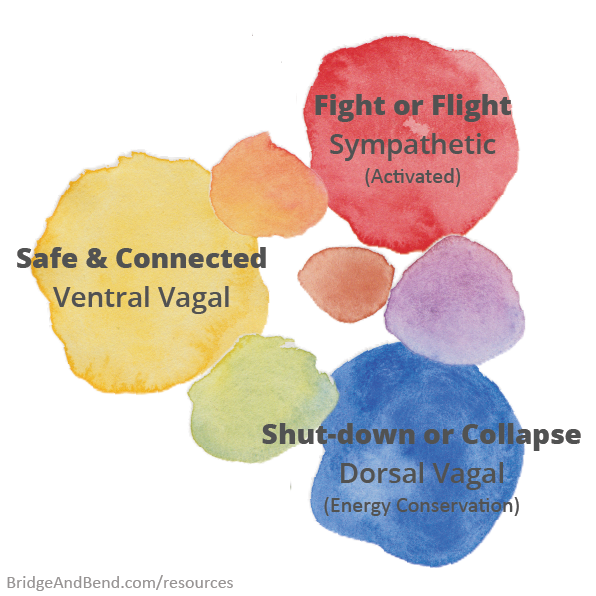
Nervous system dysregulation is what happens when you get stuck in one of those survival states. Either a single event has been severe enough to push you completely outside your window of tolerance, or you get pushed out and don’t fully reset before the next thing hits. Over time, that can lead to a dysregulated state becoming your default – and what was once an emergency response starts to feel like just the way things are.
As you rebuild regulation, you can spend more time in your window of tolerance, in ventral vagal or one of the blended states at the edge of the window. (More about blended states in the quick-glance guide – coming soon.)
Coming Back Into Your Body
The work of nervous system regulation is learning to come back into embodied presence. To understand intellectually how your nervous system works – and then, further than that, to actually feel it inside your body.
This involves interoception: learning to hear the signals your body sends to your brain, and this is intimately connected to information gathered by the vagus nerve. It also involves balancing your threat-reading system (neuroception) which can become faulty during dysregulation, pulling you into survival-brain responses rather than conscious, considered ones.
Through regulation practices and sensory grounding, we want you to feel safe enough and present enough to bring your conscious mind back online – and to start integrating what you’re feeling in your body with what you’re thinking in your mind.
From there, you can begin to select and practice tools that will move you back toward your ventral vagal state. And this is where matching the tool to the state really matters.
The Right Tool for the Right State
Tool selection is where people can sometimes get confused – and it can leave you feeling like I’m bad at regulating or maybe I’m just broken. But it’s often more a case of trying to put a picture nail in the wall with a garden shovel. Wrong tool for the job.
Two simple examples:
If you’re stuck in an activated state and tend toward panic and breathlessness when overwhelmed, going straight to a slow breathing technique may make you feel even more like you can’t breathe – and send you further into panic. It might work better to go for a short walk first.
Likewise, if you’re stuck in energy conservation and feeling numb, practising stillness might leave you feeling spacey and more dissociated. You may find more relief in sitting up straight, rolling your shoulders back, and pressing the soles of your feet firmly into the floor.
Tip: Before you reach for a tool, there’s one prior step – and it’s the one most of us skip. A quick interoception check-in to see where you actually are.
If you’re activated, you’re looking for something to gently turn the volume down and move you back toward safe and connected. If you’re in shutdown, you want to turn the volume up – to start hearing the cues from your body again, raise your energy, and bring yourself back from coldness into warmth, aliveness, and connection.
Another way to reach this point of regulation is with people in safe relationship. Co-regulation with someone calm and present is one of the fastest routes back to ventral vagal, and often the foundation that makes self-regulation possible in the first place.
Bringing It Together
Nervous system regulation is embodied presence in your body. It’s understanding how your nervous system works, building awareness of the tools available, and learning to match where you are right now to what will actually help.
Over time, as you practise coming back to regulation, something shifts. You start to spend more time in your ventral vagal state – not because life gets easier, but because your nervous system becomes more flexible. Your set point begins to move. And that is how you start to learn to trust the body that you’re in.
There’s a difference, though, between learning regulation and actually trusting your body. Regulation is a skill – you can understand it, practise it, get better at it. Trust is something else. It’s what grows slowly underneath the skill, in the quiet moments when you notice a signal and respond to it kindly instead of overriding it. When you pause before reacting. When you stop treating your body like a problem to manage and start treating it like something worth listening to.
That’s the longer arc. And it’s worth staying on it.
This week, before you reach for any tool – breath, movement, stillness, connection – try pausing for just ten seconds first. Not to analyse. Just to notice: where am I right now? Activated or flat? Flooded or numb? Somewhere in between?
That pause is the practice. And over time, it’s how trust is built.
Coming in the next few days: an at-a-glance guide to the nervous system states, simple cues for your own interoceptive body scan, and a quick-reference tool-matching guide – so you always know what your body is asking for, and what to reach for next.
🤍 Carmen
Resources & Further Reading
I’m indebted to 3 people for piquing my interest in autonomic regulation, and then teaching me most of what I know about it: Bessel van der Kolk, Jessica Maguire, and Gabor Mate. Their books are listed below. If you’re looking for something light and very practical (that still dives deep into the topic), I’d highly recommend that you check out Jessica’s book.
📖The Nervous System Reset – Jessica Maguire
📚The Body Keeps the Score – Bessel van der Kolk
📕When the Body Says No – Gabor Mate
The other posts in this series:
📃 Start here: Your Body Is Not the Enemy: Understanding Nervous System Regulation
🩻 The Vagus Nerve Explained: A Practical Guide to Nervous System Regulation
🌻Before You Go Inward: How Your Body Builds a Sense of Safety
🧘♀️Interoception: The Missing Link in Nervous System Regulation
📻Why the Body Keeps Responding: Trauma, Implicit Memory, and Nervous System Patterns
💆You Don’t Have to Do This Alone: Guided Approaches to Nervous System Regulation
🫂Wired for Connection: Understanding Co-Regulation and Nervous System Health
😤 Breathing for Nervous System Regulation: Simple Ways to Feel More Settled in Your Body
🚶➡️ Why Movement Regulates Your Nervous System (And How to Use It)
🎨 Using Creativity for Nervous System Regulation: A Gentle Way Back Into Your Body
Disclaimer: Our content is for general information only and isn’t a substitute for medical or health advice. Reading or using this content doesn’t create a practitioner-client relationship. Please speak to your healthcare provider before making changes to your health, movement, or wellness routine. Read our full disclaimer here.