
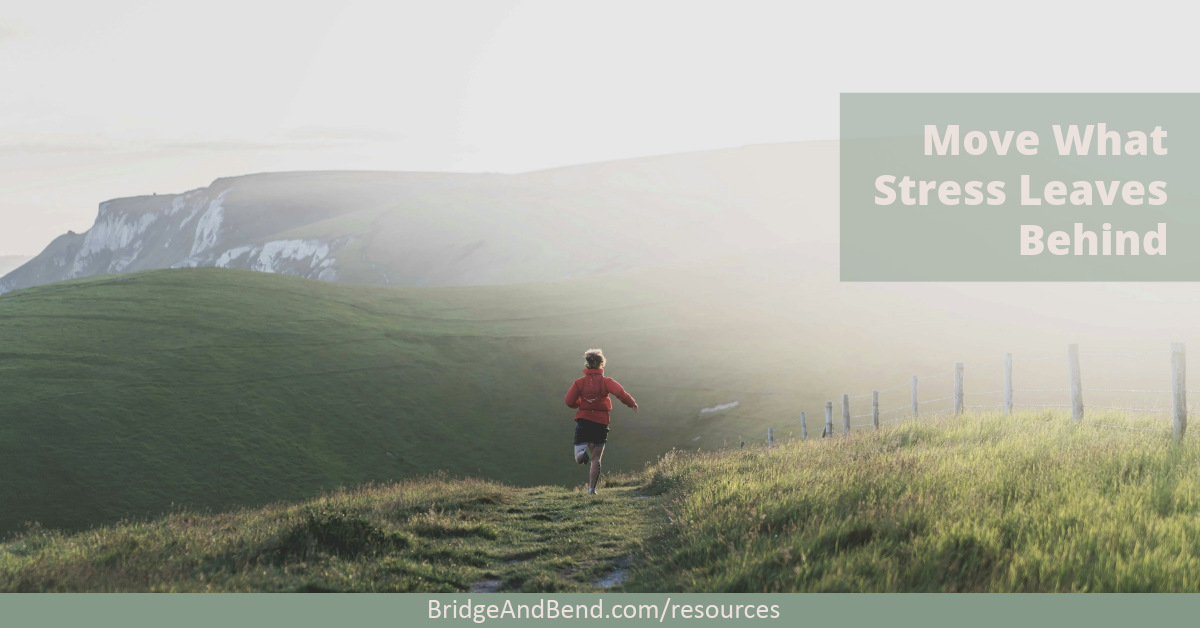
Why does doing an intense bout of exercise feel so good at the end of a tough day?
Most of you who know me know that I only ever really run under duress. The two things that get me on the road or treadmill – occasionally – are being able to understand and treat runners better as a physio, and maintaining my own wellbeing (power and spring).
But every now and then I have a day that makes me see red. And then my body CRAVES pounding it out on a treadmill…
Most of us have felt it – that particular relief that comes after a walk when you were wound up, or the way your shoulders drop after you’ve moved your body for a few minutes. We tend to credit distraction, or fresh air, or just getting out of our heads. But what’s actually happening is more specific than that – and more useful to understand.
If you’re following along with us, you’ll know we’re in a series on nervous system regulation through the body rather than the mind. Today we’re looking at how movement helps us to regulate.
Why movement regulates (and it’s not what you think)
Movement regulates the nervous system through several distinct biological pathways. This happens through physical signals of safety, release (or toning) of the nervous system, and shifts in the body’s internal chemistry. This is a big area, but here are some key ways it does that:
First, it completes stress cycles. In a sympathetic state your body produces adrenaline and cortisol to prepare for physical action – movement is how that preparation gets discharged or metabolised. Without it, those hormones linger, and your nervous system stays on alert long after the stressor has passed. This is the physiological basis for the idea that stress is meant to be moved through.
Second, rhythmic movement stimulates the vagus nerve, increasing heart rate variability and nudging the ANS toward parasympathetic tone – the rest-and-digest state we’re all under-resourced in. Think of walking, swimming, or swaying as examples of this rhythmic movement.
Third, when movement is done with attention directed inward – toward sensation rather than performance – it activates the insula, the brain region responsible for interoception: your ability to sense your own body’s signals. (This is a big topic…and we’ll unpack it more later in the series.)
Bonus insight: Myokines deserve a special mention here. These are signalling proteins released by contracting muscle tissue. They act as anti-inflammatory agents, influence brain function, and communicate directly with immune cells. Which means muscle is essentially sending regulatory signals throughout the body every time it contracts. Pretty cool, right 😉?!
This total integration of movement and nervous system is why movement is nervous system work, not just fitness. And it’s why how you move, and how much attention you bring to it, matters as much as what you do.
Movement practices for regulation [examples you can try]
These aren’t workout prescriptions. They’re invitations to use movement as a communication tool – a way of sending your nervous system the information it needs to shift state. Start with whichever feels most accessible, and notice what happens afterward.
Movement breaks: interrupting the pattern
Prolonged stillness isn’t neutral. Static postures, particularly the sustained sitting most of us do for hours at a stretch, maintain low-grade sympathetic activation even in the absence of psychological stress. Your nervous system doesn’t need a reason to stay alert; it just needs an absence of reasons to stand down.
Movement breaks aren’t about productivity or hitting a step count. They’re about not letting your nervous system fossilise in one state.
Try this – The 2-Minute Reset: Every 45–60 minutes, stand up and spend 60 seconds doing any rhythmic movement – marching on the spot, shoulder rolls, body-weight squats. Follow with 60 seconds of slow, deliberate breath (a longer exhale than inhale works well). The movement begins to clear the stress hormones; the <<breath activates the vagus nerve>>. Simple, stackable, and more effective than it sounds.
Try this – The Orienting Break: Stand and slowly look around the room – ceiling, floor, left, right – letting your eyes and head move together. Take about 30 seconds. This activates the vestibular system and sends a direct safety signal to your nervous system. It’s a core polyvagal technique, and it costs almost nothing in time and energy.
I personally love movement breaks! They’re low demand in terms of thought and time, and I feel great after them. I like to use 10-20 squats as a movement snack between patients or to break-up admin blocks. I’m always a little surprised by how much it resets things, and it has the added bonus of helping maintain healthy glucose metabolism. Also, my vestibular system can be…histrionic. (I was always the person who got seasick on the ship I worked on 🤢) The ‘orientating break’ has the bonus of reintegrating and settling it down a bit. Win-win.
Shaking: completing the cycle
This is the one that raises eyebrows, so bear with me. 🙂
After a threat, animals shake. Visibly, physically, sometimes dramatically. It’s not distress – it’s discharge. A way of metabolising the residual sympathetic activation that the threat response generated. Humans do this too, instinctively – but we’ve largely learned to override it. We tighten, hold, carry on. We treat shaking as something to suppress rather than something to complete.
Therapeutic shaking reactivates that innate discharge mechanism. It’s not losing control. It’s finishing a biological cycle the body already started.
Try this – Guided Shaking: Stand with soft, slightly bent knees. Begin a gentle bounce — just enough to feel the body move loosely. Let it travel upward through your legs, hips, and belly. The goal is loose and a little uncontrolled – slightly ridiculous is a good sign. Continue for 2–3 minutes, then stand still and simply notice. What’s changed? Where do you feel it?
Fair warning: this feels deeply strange the first time. Do it alone if you need to. It gets less weird. 😄
Note: This is not a true ‘neurological shaking’ exercise, such as those taught in TRE (tension and trauma release exercises). We’ll be discussing facilitated techniques such as TRE in a future post.
Somatic movement: slow enough to listen
Somatic movement is not stretching. The goal is not range of motion, flexibility, or any kind of performance. It’s sensation. Specifically, it’s slow, attentive movement that gives the nervous system enough time to actually register what’s happening – to rebuild the conversation between body and brain that chronic stress, pain, or disconnection tends to erode.
The underlying mechanism worth knowing about is pandiculation – the neurological sequence of contract, slow release, and rest that recalibrates resting muscle tone at the nervous system level. It’s what’s happening in that instinctive full-body morning stretch. Done intentionally and slowly, it’s one of the most direct ways to reset habitual tension patterns. To make the most of this, it’s a great idea to end these exercises with a period of stillness and checking in.
The slowness here isn’t because this is easy or passive. It’s because speed bypasses sensation – and sensation is the whole point.
Try this – Somatic Cat-Cow: Rather than moving through your spine for range, move for feeling. Go slowly enough to sense each segment of your spine as it moves. Pause at the end ranges. Notice where movement feels fluid and where it feels absent, unfamiliar, or slightly blank. You’re not trying to fix anything – you’re mapping. The attention itself is doing the work.
Try this – Hip Circle CARs (Controlled Articular Rotations): You may have done these before as a mobility warm-up – here we’re using them differently. Stand with soft knees and hands resting lightly on your hips (or on a wall in front of you). Begin to trace a slow, deliberate circle with your hips – as large and as controlled as you can make it. Move slowly enough to feel the movement change quality as it travels through different parts of the arc. Where does it feel smooth and familiar? Where does it feel sticky, unfamiliar, or like the signal drops out? Those blank spots are your map. They’re not problems to fix right now – they’re simply information. Come back to them with curiosity rather than effort.
Both the somatic cat-cow and hip circle CARs are exercises I use regularly in my practice. They’re gentle, often feel really good, and open a door for patients to get genuinely curious about feeling movement in their body. There’s something particularly rewarding about giving these as homework and having someone come back saying: “it felt so clunky at first – but now I can feel the whole movement, and my body feels more settled afterward.” That shift, from clunky to connected, is exactly what we’re going for.
A note before you move on: you don’t need to do all of these. You don’t need to do any of them perfectly. The nervous system responds to repetition and attention – small, consistent doses of any of the above will do more over time than an occasional intensive effort. Start with one. Notice what happens. That noticing is already regulation in action.
Final thoughts
I’m a movement professional and I’ve been active and involved in sport my whole life. Which might make me a bit biased 😉 But I genuinely believe that regular movement helps me to stay regulated, present for clients and loved ones…and just brings more joy to my life! And I see versions of that shift in patients every week.
The goal isn’t performance or aesthetics. And yes, movement and exercise is great for health. But gentle movement to regulate your nervous system and burn off cortisol has health benefits that go well beyond pure ‘fitness’.
Try exploring a few…and let me know what you discover!
🤍 Carmen
Coming up: Next week we’re going to unpack more about the vagus nerve, and discuss some of the regulation ‘hacks’ that are everywhere online at the moment.
Further reading
📃 Start here: Your Body Is Not the Enemy: Understanding Nervous System Regulation
🎨 Using Creativity for Nervous System Regulation: A Gentle Way Back Into Your Body
😤 Breathing for Nervous System Regulation: Simple Ways to Feel More Settled in Your Body
Disclaimer: Our content is for general information only and isn’t a substitute for medical or health advice. Reading or using this content doesn’t create a practitioner-client relationship. Please speak to your healthcare provider before making changes to your health, movement, or wellness routine. Read our full disclaimer here.