

There’s a monthly market that I love to visit with a few close friends. They hang colourful bunting between stalls in a local park. The cheerful stands sell an eclectic selection of hand crafted homeware, thrifted clothing, and artisanal treats. And at the bottom of the park is a picnic area and live music, surrounded by food trucks.
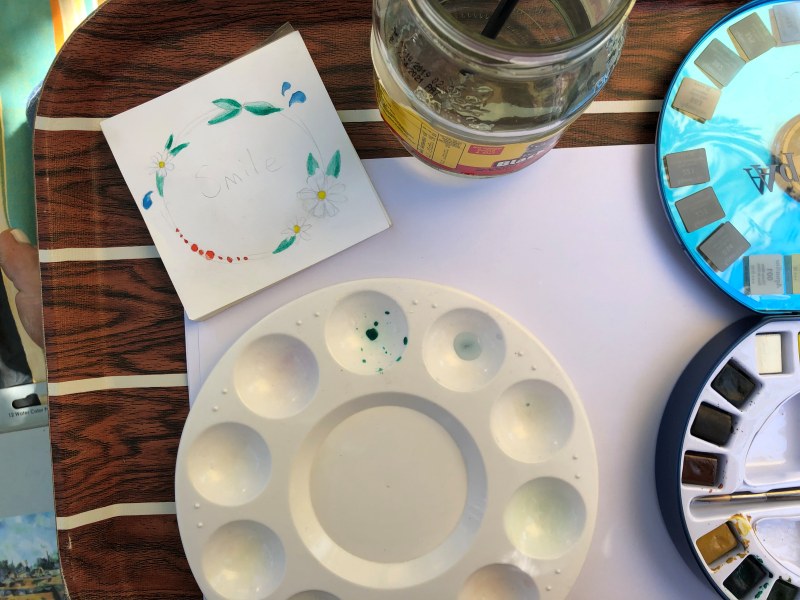
We love to wonder the market, get a coffee or lunch, and then settle down on a picnic blanket…often to sit and create together. I love bringing my watercolours, and either doodling, sketching what is around me, or journalling a Bible verse. My mind seems to gently drift, and my senses ‘expand’. Sometimes we chat, and sometimes we just create together. It is such a beautiful, grounding way to spend a few hours.
Often I arrive at the market tired, my mind spinning after a busy week, and sometimes even a little anxious about all the things that need to happen before Monday morning. But that creative pause (no doubt helped by the presence of people I love and some time outdoors) always leaves my mind and body feeling like they’ve taken a giant, relaxing breath. I feel calmer. Open. Settled.
And this is exactly the effect that art and creativity can have. Creative expression gives your nervous system something it often needs more than insight – a safe, sensory way to slow down, feel, and reconnect.
Today is World Art Day, and it seems like such a perfect gateway into exploring ways that we can connect with our physical body and learn nervous system regulation.
Some theory: Why this works
Last week, we opened this series on nervous system regulation by looking at what that actually means, and briefly exploring the autonomic nervous system (ANS) and Polyvagal Theory. We introduced the idea of regulation as flexibility – having the range and resilience to move between different states, rather than getting stuck in one.
But when your nervous system is overwhelmed, it’s often very hard (if not impossible) to “think your way out” of how you’re feeling.
This is where body-based regulation becomes so valuable.
When you begin to tune into your body – your senses, your breath, your physical experience – you give your nervous system a different kind of input. One that signals safety from the inside out. And this is what allows the system to start settling and shifting again.
Today, we’re exploring creativity as one of those pathways.
Creativity as a regulation tool
At its core, creative expression supports regulation because it works bottom-up (body → brain) rather than top-down.
Creative activity gently:
- engages the body and senses
- introduces rhythm and repetition
- allows controlled, contained expression
- reduces reliance on words and analysis
This aligns with principles from Polyvagal Theory, which emphasise that regulation happens through felt experience, not just thinking.
So instead of trying to force yourself to “calm down,” creativity gives your body another pathway back to safety.
A quick note before we begin:
Art and creative expression can be powerful tools for processing emotion and experiences. In a therapeutic setting – such as Art Therapy – this is done with the guidance of a trained professional, and may involve accessing deeper or more difficult material.
That is not the aim of this post.
Here, we’re focusing on using simple, gentle creative practices to explore your senses, reconnect with your physical body, and support nervous system regulation.
Think of this as exploration, not excavation.
Why art works (from a nervous system perspective)
When the nervous system is dysregulated, the thinking part of the brain is often either:
- Overactive: racing thoughts, anxiety, rumination [sympathetic] or
- Underactive: numbness, flatness, disconnection [dorsal vagal]
Creative activity offers an alternative route.
It reduces the demand on verbal processing and instead engages sensory and motor pathways – giving the nervous system a more accessible way to settle and reorganise.
Here are a few of the key ways this happens:
✋Sensory grounding
Working with colour, texture, and pressure (like pen on paper or hands in clay) helps anchor your attention in the present moment.
This can:
- reduce rumination
- interrupt anxious thought loops
- gently bring you out of shutdown
It’s a simple but powerful shift – from thinking about your experience to actually feeling it.
🔁Rhythm and repetition
Doodling, shading, or repeating patterns introduces predictable, rhythmic movement.
This kind of repetition is inherently regulating. It mirrors other calming inputs in the body, like walking or slow breathing, and can help stabilise the nervous system.
☀️Focused attention (“soft flow”)
Creative activities often sit in a sweet spot – not too demanding, but not passive either.
This creates a gentle “flow” state where:
- your attention is focused
- your mind quiets slightly
- you become more present
It’s not about zoning out, but rather softly tuning in.
🔥Safe expression of activation
Sometimes the body is holding onto stress, frustration, or emotional energy that hasn’t had a chance to fully move through.
Creative expression offers a contained way to release some of that:
- pressing harder with charcoal
- making fast, messy lines
- using bold or contrasting colours
This allows for small, manageable “discharges” of energy – without becoming overwhelming.
🫀Reconnecting with the physical body
This is where it becomes especially relevant to movement and rehab.
Creative work engages:
- touch (materials, pressure)
- vision (colour, form)
- movement (hands, posture, coordination)
Over time, this builds:
- interoception (awareness of internal sensations)
- proprioception (awareness of your body in space)
These are foundational for:
- reconnecting with your body
- improving movement confidence
- rebuilding trust in what your body can do
(More on these in upcoming posts…)
So… Can simple, joyful creation actually improve wellbeing?
Yes…with one important nuance.
It’s not about the quality of what you create. It’s about the state the process helps you access.
When approached gently and consistently, simple creative practices can:
- reduce baseline stress levels
- support emotional regulation
- increase body awareness
- help you come out of cycles of overwhelm or shutdown
And importantly, they create a bridge back into movement.
Because when your body feels safer and more familiar, it becomes much easier to move with confidence again.
What makes it “work” (and what doesn’t)
Creative practices are most regulating when they feel:
- low pressure (no outcome required)
- sensory (focused on feel, not thinking)
- time-limited (5–15 minutes is enough)
- choice-driven (you decide what and how)
You might think of the tone as:
simple, curious, playful, exploratory
On the other hand, it can become less helpful – and even dysregulating – if it shifts into:
- perfectionism (“this must look good”)
- self-judgement
- overwhelm (too open-ended or too long)
- emotional intensity too quickly
If you notice that shift, it’s a sign to gently scale things back.
Simple, body-based creative prompts
If you’d like to try this for yourself, here are a few simple ways to begin.
Keep it short (5–15 minutes), and approach it with curiosity rather than expectation. These are less “art exercises” and more nervous system practices using creativity.
- Doodling with awareness
Let your pen move freely while noticing the shapes you create and the feeling of the paper beneath your hand.
One variation I love is “scribble + breathe”:
draw continuously for 1–2 minutes, and experiment with matching your movement to your breath (a slower exhale = slower lines). - Colour your state
Fill a page with colours that feel right for how your body feels – no need to make it look like anything. - Repetition with variation
Choose a simple shape and draw or paint it repeatedly, changing the size, colour, or direction each time. - Creative reflection
Try watercolour journalling around a quote or Bible verse. Let your attention move between the words, the colours, and the physical act of creating. - Bilateral play
Use both hands – finger painting, clay, or even alternating hands while drawing – to engage both sides of the body and brain.
As you create, stay gently present to what you can see, feel, and sense.
Add a layer of depth: A simple check-in
Before you start, ask:
What do I feel in my body right now?
After a few minutes, ask:
What feels different?
This small practice builds something really powerful over time: evidence that your body can shift.
A gentle safety note
The practices suggested here are for gentle exploration, not emotional excavation.
Start small:
- 5–10 minutes
- simple materials
Stay anchored in your body:
- notice your feet on the ground
- feel the hand holding the pen
If you notice signs of overwhelm – like a spike in anxiety, feeling disconnected, or a strong urge to stop – pause.
Take a moment to:
- look around and orient to your environment
- name a few things you can see
- return to something grounding (movement, water, touch)
When to seek support
If strong emotions feel unmanageable, or if you notice that you feel worse after trying these practices, it’s important to reach out for support.
Just as you might see a physiotherapist for a physical injury, working with a trained professional can help you navigate emotional or nervous system challenges safely.
This might include:
- psychologists
- trauma-informed therapists
- art therapists
Where art therapy fits in
Art Therapy is a guided, therapeutic use of creative processes facilitated by a trained professional.
The practices above are designed for everyday support – helping you regulate, reconnect, and build awareness through gentle exploration.
If you find the practices here helpful, and are navigating chronic stress or past trauma, working with a trained professional can offer a deeper, more supported way to explore this work.
Final thoughts
Before we ask the body to move better, we often need to help it feel safer. Sometimes that safety and reconnecting with your body doesn’t start with exercise – it starts with noticing, feeling, and maybe gently creating. And that creating can be as simple as putting pen to paper.
Creativity allows us to explore another side of ourselves, and get lost in the process and sensory experience. By exploring and experiencing our minds and bodies in different ways, it helps us to regulate over-arousal, become more familiar with what we’re capable of, build our resilience, and boost our body-trust.
And sometimes…playing with paint is just fun 👩🎨
Happy creating!
🤍 Carmen
Further resources
Your Body Is Not the Enemy: Understanding Nervous System Regulation
Disclaimer: Our content is for general information only and isn’t a substitute for medical or health advice. Reading or using this content doesn’t create a practitioner-client relationship. Please speak to your healthcare provider before making changes to your health, movement, or wellness routine. Read our full disclaimer here.