

A Practical Tool to Match Your Workout to How You Feel
Ever get halfway through a workout and get that sinking feeling – “This was a bad idea…my body just can’t cope today”?
And then wonder where that came from – you smashed yesterday’s tougher session with ease!
That’s your body showing you how its capacity shifts from day to day. It’s all based on an overall mental, emotional, and physical capacity that’s impacted by the hundreds of small things that make up daily life.
In this post, we’ll explore a simple tool – the Energy Bank Check-In – to help you match your movement to your body’s capacity on any given day. It’s a practical, self-guided method to balance energy, movement, and recovery.
At its heart, it’s all about becoming more mindfully present in your body and your life – so you can build a healthy lifestyle and live with more intention, energy, and joy.
The Energy Bank Concept
Think of your energy like a bank account.
Every stressor – physical, mental, or emotional – is a withdrawal.
Every moment of rest, nourishment, or joy is a deposit.
The goal? To make movement decisions that don’t overdraft your account.
💡 Tip: This idea builds on themes from our Rest & Recovery series – especially the posts on Types of Rest and Sleep Hygiene. Pop over and have a read if you’d like to dig deeper.
In the context of the Energy Bank Check-In, we’re looking at your overall physical capacity for movement and exercise, influenced by your physical, mental, and emotional state. Awareness of this capacity helps you decide whether to follow your planned workout, adapt it for a higher or lower capacity day, or swap it for some mindful, restorative movement instead.
As you learn to tune in to where your body is on any given day – an internal awareness of your current capacity, or the “balance” in your energy bank – you’ll start making movement choices that support both today’s energy and your future resilience.
This awareness is key to staying consistent with exercise and building a healthy, trusting relationship with your body. Forcing tough training on a depleted system can so easily lead to injury or burnout.
The good news? By using this simple tool, you can begin to reconnect with your built-in body wisdom and rebuild the trust that supports a thriving, balanced life.
The Energy Bank Check-In
Use this quick check-in to assess where your body is at before you train. It takes less than two minutes and helps you choose the right kind of workout for your day.
Work through and see where you are in each line. Then total your scores at the bottom.
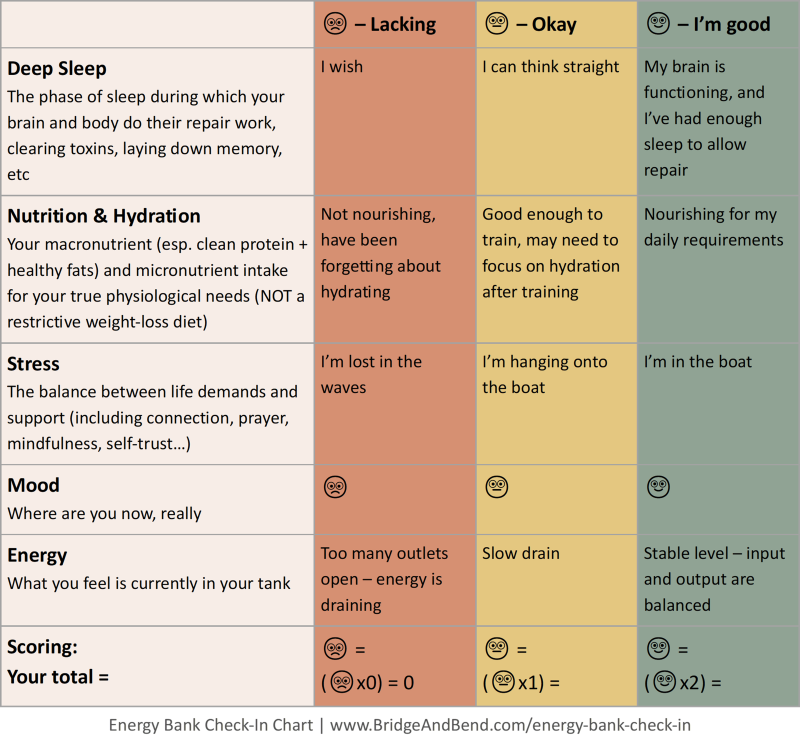
Scoring your capacity in this way builds your internal awareness. This helps you reconnect with your body and make choices that support consistency over intensity.
💡 Tip: If you’re unsure, go with your lowest score for the day – your body will thank you.
Interpreting Your Score
Regularly training at a level your body can truly handle builds body-trust and sustainability – helping you maintain long-term strength and health. Here’s how your score helps you to choose how to train to match your capacity.
Once you’ve totalled your score, match it to the movement type below:
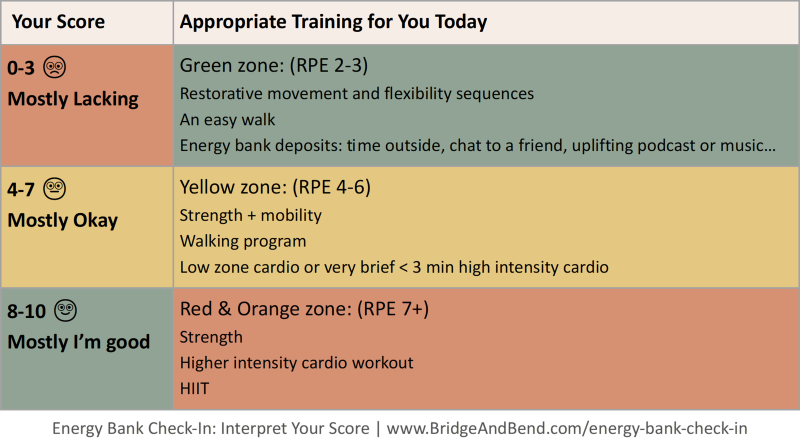
On days where you have a lower score, be intentional about depositing into your energy bank. Time in nature, do something creative, phone a special person. For more ideas, check out different types of rest.
Track Your Energy Over Time
Try tracking your Energy Bank scores over time:
- What are your averages over a week or a month?
- Are you comfortable with that?
- Would your healthcare professional (or a wise friend) agree?
💡 Tip: If you notice a pattern of depletion, it might be time to revisit your rest, nutrition, or stress balance – or speak with a professional who can help you recalibrate.
Understanding RPE (Rate of Perceived Exertion)
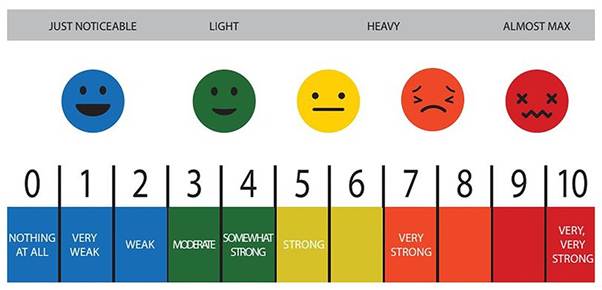
The RPE scale helps you measure intensity based on how your body feels – not your smartwatch. It’s a practical, intuitive way to align your effort with your energy.
And a bonus for me: it retrains your mind-body connection and helps you rebuild trust in your body’s wisdom 😉
What the RPE Training Zones Mean
Here’s a simple visual guide:
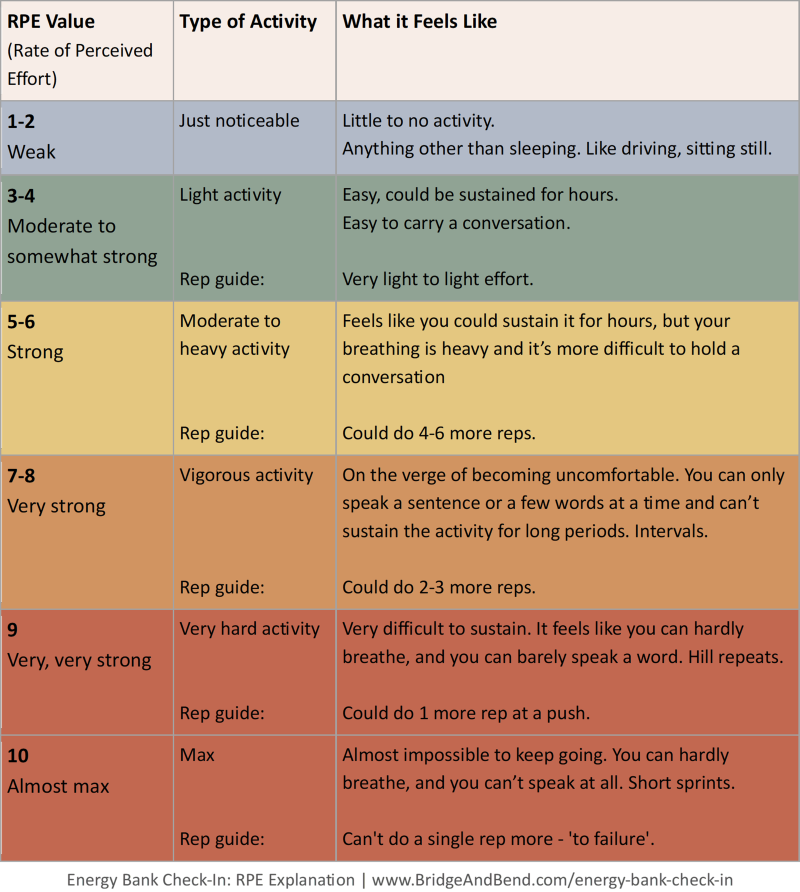
And here’s what you might feel in each zone, along with examples of the types of exercise that fit:
Applying the Energy Bank Check-In in Daily Life
Making movement a sustainable part of a full and thriving life is what we’re really aiming for here – learning to find the joy in movement, and using it as a tool to take care of ourselves well.
When you move in tune with your energy, you rebuild trust and a positive relationship with your body. And over time, you’ll find that consistency, not intensity, is what creates lasting change.
So why not challenge yourself to do an Energy Bank Check-In every morning for a month? (Go on…pop it in your calendar. I’ll wait 😉)
Consistent use will build awareness of your capacity and create a habit of checking in with yourself daily. Double win!
If you’d like to learn more about building consistent, restorative movement into your week, explore our Rest & Recovery series or our Body Renewal & Core Connection program – designed to help you reconnect with your body and move with confidence.
🤍 Carmen
References
📃WellMom resources from carmenphysio.co.za
📃Frontiers In Physiology: Methods to Monitor Internal Training Loads
📃Cleveland Clinic: Rated Perceived Exertion (RPE) Scale
📃Original BORG Scale on Research Gate
📃Autoregulation by Stronger By Science
Disclaimer: Our content is for general information only and isn’t a substitute for medical or health advice. Reading or using this content doesn’t create a practitioner-client relationship. Please speak to your healthcare provider before making changes to your health, movement, or wellness routine. Read our full disclaimer here.