
🎬Video player not displaying? Watch it here.
3D Core & Breath Reset — FREE mini program
Breath, Movement, and Body Trust (Without the Woo)
Breath and core connection. Pairing breath with movement. Body trust. Embodied presence.
I know how those phrases can sound — a little fluffy, maybe even a bit woo. So today we’re taking it back to something really practical. We’re going to work through and experience what it actually feels like to pair your breath with your movement — non-judgementally, in a “there’s no right or wrong here” kind of way. Practising that pairing, even a little, is a great place to start feeling the joy of moving with the freedom that breathing well can bring.
Why Breath Matters More Than You Think
Breath is central to how your body functions. Your diaphragm moves more than 20,000 times a day, and that ties directly into how your 3D core moves through what I call the core piston — something we explored in last week’s post, and go much deeper into in 3D Core & Breath Reset.
When you’re learning to balance pressure through your abdomen — so you’re not bracing, and not constantly pushing pressure down into your pelvis — good pressure control starts with something surprisingly simple: how you breathe.
During Everyday Movement
For low-threshold movement — getting up from a chair, walking down the passage, turning over in bed, picking up a coffee cup — movement should be fairly effortless. You shouldn’t need to think about breathing through it. But you also shouldn’t be holding your breath while you do it.
Learning to breathe easily through movement helps you control abdominal pressure, and it also teaches you what it feels like to move with ease — where your body is working with you rather than against you.
During Formal Exercise
When it comes to more structured movement — Pilates, yoga, even weightlifting — being intentional about how and when you breathe can help you get far more out of what you’re doing.
Unless you’re doing something genuinely heavy, your breath strategy should rarely be to lock your breath down entirely. That kind of breath-holding has its place — think of a rugby tackle, or a heavy deadlift — where you’re using your breath as part of your core to create strong, deep bracing and pressure support. But that’s a high-threshold strategy, and for most moderate movement, it’s actually counterproductive.
For moderate exercise, a useful tip is to breathe out with effort. You can also pair your breath with movement to mirror how your core piston naturally moves. Take a squat: as you lower down, your pelvic floor lengthens and your core piston descends — so breathing in on the way down and out on the way up works with your body, not against it.
That’s not quite what we’re exploring today, though. Today is simpler: just noticing how matching your breath to your movement feels in your body — and how that can unlock a real sense of freedom.
Two Trains on Parallel Tracks
Here’s the image I like to use: think of your breath and your movement as two trains running along parallel tracks. Neither one should pull ahead of the other. You don’t want to move, then have your breath catch up, then hold your breath while your movement waits. You want the inhale and the exhale to move in step with the movement — arriving together, every time.
If you’re doing a bicep curl, or a sit-up, matching your breath to the movement is a great place to start.
To be clear — the patterns below aren’t the “correct” way to build strong, deep core engagement. That’s a different exercise for a different day. Today is about feeling what it’s like to add a layer of complexity to movement, and noticing what breath adds when it’s there.
Before You Begin: Ground, Then Wake Up
Before moving into the practice, take a moment for a quick sensory grounding technique — a fast scan of things you can see, hear, smell, or simply feeling the ground underneath you. Just connect into the world you’re in.
From there, we move into something that wakes up your body — a proprioceptive presence exercise, so you can feel your body moving in space. Only then do we move into actually pairing breath and movement — keeping those two trains running together on the tracks.
Try this:
Stand somewhere with a little space around you, feet about shoulder-width apart. Feel your whole foot on the ground — the base of your big toe, the base of your baby toe, your heel. Close your eyes if that’s comfortable.
Slowly shift your weight side to side, feeling how it moves through your feet and into the ground. Let your arms swing if you want to. Turn it into a gentle sway — circling side to side, feeling the air move around your arms, your weight shift leg to leg, your body move in space. Easy breathing throughout. Stay here for a few more seconds, then come back to centre and open your eyes.
Notice — does your body feel a little more awake and ready now?
The Practice: Pairing Breath With Movement
1. Arms Overhead
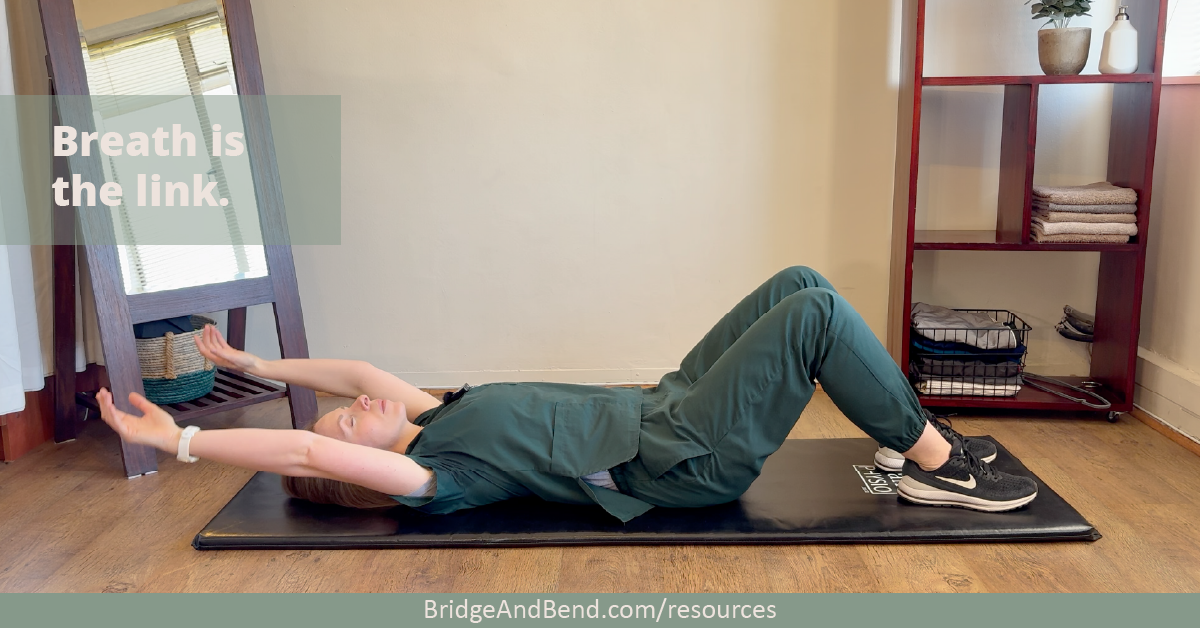
Lie down on the floor — a mat, carpet, or towel is fine — with space to move your arms freely.
Take a full breath in as you bring your arms up overhead to the floor, and a full breath out as you lower them back down. Don’t overthink it — nothing here needs to tense, connect, or tighten. Just breathe in all the way through the movement, and breathe out all the way through the movement.
Aim to reach the end of your inhale exactly as your arms reach the floor — pause for a beat if you need to — then a full exhale as your arms return to your sides. Repeat for five breaths, adjusting your pace as needed so the trains stay on the tracks.
2. Shoulder Bridge With Arms
Now we add a shoulder bridge — lifting your hips off the floor — combined with the same arm movement.
If you’ve done Pilates before, you’ll know the usual pattern is to exhale as you lift and inhale as you lower. We’re doing the opposite today, on purpose — pairing the lift with the same breath pattern as before. This isn’t about using breath to drive core engagement; it’s about getting familiar with breathing through movement.
Feet in, arms by your sides. Take a full breath in as you lift your arms up to the floor and your hips up off the mat together. Exhale as your hips and hands return to the mat, together. Repeat for five breaths. If you get unsynchronised, pause and let the next breath reset it.
3. Standing Reach at the Wall
Stand facing a wall, hands resting on it. Inhale as you reach up and over to one side — pairing the fullness of your chest with the fullness of the movement — then exhale as you return to the start. Repeat on the other side.
Keep your chest reaching up and over rather than collapsing down. Two reaches on each side, breath and movement matched all the way through.
Tip: If that felt good — if you noticed even a little freedom of movement in your body — you’ve just felt breath act as the link. 3D Core & Breath Reset takes that same link and shows you what happens when it drives your core, not just your movement. That’s day one.
Where This Leaves You
Hopefully you’ve felt, in your own body, what it’s like to pair breath with movement — and maybe a little of the freedom that comes with it.
But notice what you were actually practising: breath as the link between you and your movement. Today, that link just kept things moving freely. It didn’t yet ask anything of your core.
That’s the next step — and it’s exactly what 3D Core & Breath Reset walks you through, in three days, for free. Same link, same breath, but now it’s driving something: real, functional core engagement, not just ease of movement. Women who’ve been through it tell me it’s the first time core work has actually made sense in their body, not just in their head.
“I found the explanations about how to become aware of one’s core, how to engage the core and why that’s important very useful.” —MH
If today felt good, day one of 3D Core & Breath Reset is where that same link starts to do more.
🤍 Carmen
Reading and Resources
🧘♀️3D Core & Breath Reset — FREE mini program
📃Before You Go Inward: How Your Body Builds a Sense of Safety
📃The Problem With Always Bracing Your Core
📃More Than Crunches: The 5 Key Functions of Your Core Explained
🤸♀️Body Renewal & Core Connection — 4 weeks to core strength and body trust
Disclaimer: Our content is for general information only and isn’t a substitute for medical or health advice. Reading or using this content doesn’t create a practitioner-client relationship. Please speak to your healthcare provider before making changes to your health, movement, or wellness routine. Read our full disclaimer here.