
🎬Video player not displaying? Watch it here.
Body Renewal & Core Connection
You know that feeling when you get home at the end of a long day, walk in the door, and your hair that’s been down all day has to be tied up. Right now. Instantly.
That familiar trigger, arriving home at the end of a workday, sets off the behaviour of tying your hair back. That’s a habit. But what a lot of us don’t realise is that we have movement habits too.
A movement habit is a movement your body does automatically in response to a familiar situation or demand.
Movement is a behaviour produced by the brain, just like any other task or habit that we do. So it makes good sense that they have similarities. They’re not identical, but there are a lot of overlaps. So today I want to look at how our everyday habits work, and how that shows up in the way we move, and what that means for our movement lives.
How habits work
With a habit, you have a situation (or trigger event), and an automatic response to it. The conscious thought and decision steps are skipped. You almost don’t even need to think about it.
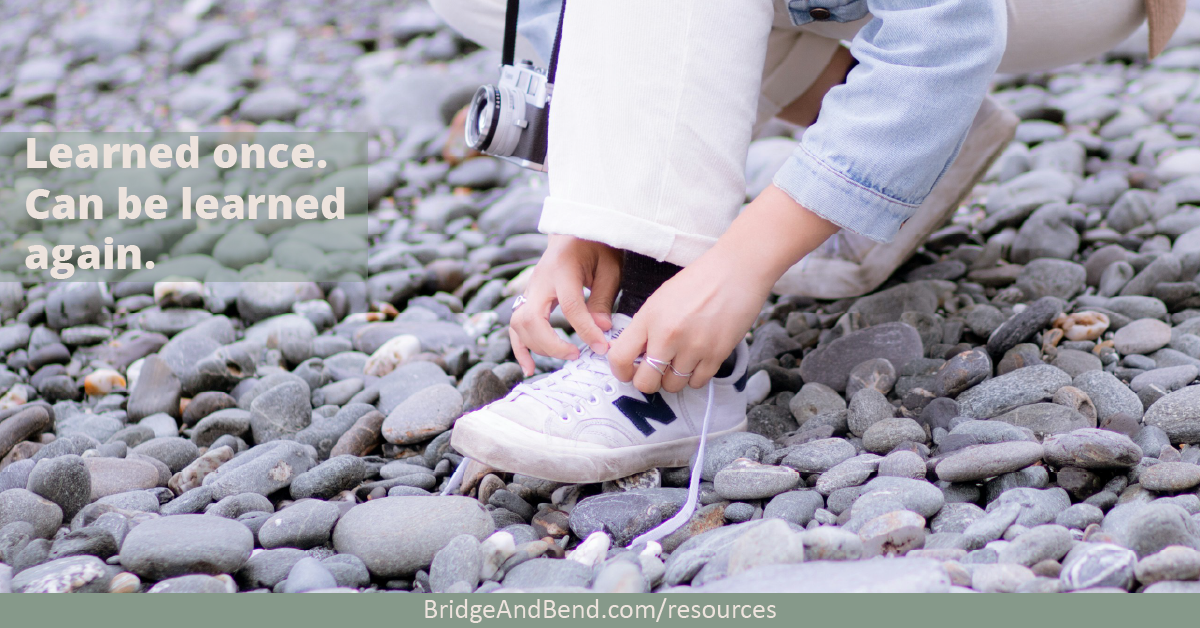
Tying your shoelaces is a movement habit
Let’s look at a learned behaviour that is actually movement, but that we don’t normally think of as movement: tying your shoelaces.
There was a point in your life where somebody had to sit you down and teach you how to tighten your laces and tie a bow. You had to learn the steps, and practise them. But now you pull your shoes on and tie them off without even considering what you do. Your mind and body just slip into the familiar pattern of getting dressed.
Mini aside… in my case, the same goes for untying shoes. I have one pair of lifestyle sneakers where the laces are really just decorative. I can slip them straight off, but I regularly realise I’ve untied the laces anyway, because that’s the default habit that happens when you bend down to take off shoes with laces on them 😂
Your mind learns the pattern. It’s triggered by something, you don’t really think about it, and you just move into the behaviour.
Our brain runs movement and habits in a similar way, and there’s a really good reason for it: it decreases the cognitive load of getting through tasks every day. Putting certain things on autopilot takes so much less effort for your body and your brain.
What goes into a habit: skill, trigger and outcome
Let’s break down what’s actually in a habit, so we can see how it factors in when we’re retraining movement habits and movement patterns.
- Skill: the ability to perform the behaviour the task requires
- Trigger: the situation, place, time, request, or demand that tells your brain to move into the learned skill
- Desired outcome or result
Shoe example:
- Skill: learn to tie laces, then practise until you’ve mastered it
- Trigger: putting your shoes on
- Desired outcome: snugly fitting running shoes, so you can go for a walk with your family
The outcome matters more than it looks. Getting your shoe on and tied is a little mini reward in itself, and it’s that reward that wires in a reliable pattern.
Before the trigger: awareness
There’s a step that comes before all of this: the decision of what to do. Sometimes that’s conscious and sometimes it’s not. So with lifestyle habits, awareness is often an important first step.
Shoe example: if you tend to wear out the back of your shoes by pulling them off with the laces still tied, you need to catch yourself the moment before you pull them off, as you’re about to collapse on the couch. That moment of awareness gives you a chance to make a conscious decision, trigger the new behaviour, and start to change the habit.
When the skill isn’t there yet
Imagine you want to cook healthy, homemade meals… but you’ve never cooked before. There’s a big gap between the outcome you want and your level of skill. No matter what you do, you’re never going to get a homecooked meal unless you take steps to learn a few new skills: chopping, sautéing, flavouring, following a recipe…
Let’s take it back to movement.
How we learn movement patterns
Babies are born without very many movement skills. Over the first year or two of life, they learn to lift their head and control their neck. To roll over, sit, crawl. Then they pull up to standing. Take steps. Walk, run… and before you know it they’re running around like little whirlies and you have to keep an eye on them to make sure everything is safe.
What’s foundational here is that each level builds on the last. Movement patterns stack. There’s a foundation of things we should all be able to do, and then we learn the next skill based on the previous one. Which brings us back to skill in a habit: we learn basic component skills that stack together to give us smooth, controlled movement.
After a while, walking and moving becomes habitual, with no effort or thought required.
Why your movement habits might have changed
But life can still impact this. Accidents and injuries. Physical or mental trauma. Pain and nervous system regulation. Being stuck in only a handful of postures. A general lack of movement and exercise.
These can shift two things:
- our relationship with our body and movement
- our default movement habits
And these two essentially play out together. You can’t really tease them apart in everyday life. Think of that stressed cashew-nut hunch while you’re typing on your computer all day. That’s life, that’s posture, and that’s habit, all rolled into one.
These are some of the barriers to moving well, or things that can change our movement patterns:
- Dissociation or disconnection, feeling a little distanced from your body. This can be linked to pain, nervous system dysregulation, or trauma.
- Lifestyle: how much rest you’re getting, how you’re nourishing your body, the food you’re eating, whether you’re managing stress, and the time pressure of it all.
- Body mistrust: a breakdown in listening to the signals your body gives you and in controlling how it moves. This can come from injury, from not being present or mindful, and from pressure outside of you, like an aesthetics-first mindset about your body, movement and food. Gradually, that starts to break down how you listen to the signals coming from your body.
If some of this sounds like where you are, a physio or other qualified health professional can help you work through it.
But that doesn’t mean it will stay that way. We can take small, consistent steps to change our relationship with our body and reset our movement patterns into things that serve us day to day.
How to change a movement habit: 5 steps
Here are the steps we go through when relearning a movement and making it habitual. After this, I’ll take it through a super simple example: climbing stairs.
1. Awareness
The first step is often gaining awareness. Shoe: realising you need to tie it better when it keeps falling off as you hike up a hill. The shoe falling off brings the problem into awareness, and then you can problem-solve.
With movement, this awareness might come from:
- pain or injury
- trying something new at golf or padel and just not “finding it”. You can’t quite wrap your head around what you need to do with your body to make the shot
- a physio or trainer noticing something in how you move, pointing it out, and helping you untangle where to go next
2. Set-up
The set-up is the environment around the behaviour, which ultimately becomes the trigger that moves you into your automatic behaviour. It’s putting together the pieces that will take you down the ladder of learning the new movement pattern, and thinking about where you’ll apply it in future.
That might be a class, a trainer, rehab with a physio, or a home program. Environment = the trigger.
3. Learn the skill
Being taught how to tie the bow. With movement, it might be working through cues like pressing through your foot when you balance on one leg to re-establish balance patterns. It’ll look different depending on the skill you’re learning.
4. Practise
The right skill, in the right context, enough times. There’s a bit of a progression:
- Break it down so your body can feel the movement. Be aware of what you’re doing.
- Introduce very conscious, very small-scale versions of the movement.
- Scale it up, with different levels of challenge, making it harder and building strength as you go. This is the capacity that supports the skill.
- Start applying it in everyday context, adding more function now that you’ve learned the fundamental skill.
This builds skill, intentional awareness, and the strength you need to do it easily (capacity).
5. Automate and make it the default
This comes from practising with the full recipe: the movement demand (the thing that triggers your brain to remember we need this movement, whether that’s a situation, an environment, or literally needing to put your foot on a step), the skill you’ve learned, done enough times to get the outcome you want, and then coupling that outcome to feeling successful.
But also… reward. The often-missing piece. Reinforcement, intentional celebration, feeling it land in your body.
If there’s something you’ve been struggling to do, like moving fluidly through your spine, there’s a moment when you finally do it again and your brain goes, “Oh, that’s what it feels like.” It kind of lands back in your body. Being consciously aware of that moment, the satisfaction and feeling good as you move, is a built-in reward in learning a new movement skill.
BJ Fogg, who wrote Tiny Habits, talks about “shine”: that internal felt sense of self-recognition and achievement, a little glow within you. I think our bodies have a way of taking a deep breath that feels a little similar: ah, there it is. Being aware of it, and consciously letting my brain see it when I’m learning something new, makes my brain learn that pattern so much quicker.
Example: climbing stairs
Let’s climb some stairs. It’s a silly example, but bear with me.
The trigger: approaching a flight of stairs. That brings the desired behaviour to the front of your mind: you need to plug in the automatic behaviour of walking up.
Now break it down. To walk upstairs, you need to lift one leg while balancing on the other. One leg does something different to what the other leg is doing, and the standing leg needs balance control. Go back a step further and you need a stable torso to hold that balance, and to move one leg without your torso collapsing and wobbling all over the place. That comes back to a basic level of core control.
So if you were relearning how to walk up stairs, you’d work through all of it:
- re-establish basic core and postural control
- build a bit of strength
- work on balance
- work on lifting one leg
- work on one step, then a few steps with support
- take away the support
- build the skill, and build the capacity (the strength to match the skill)
- do it enough times, with that feeling of success at reaching the top, until it wires into a pattern in your brain
Once it’s solid, add challenge, like carrying groceries up the stairs.
Where core control fits in: basic core control is a great skill to learn, because so many of our movement patterns are built around it. That’s what I teach in Body Renewal & Core Connection, my four-week online program. It teaches you these foundational control aspects, including moving fluidly through your spine, and it gives you a good foundation of movement patterns that you can plug into daily life and other exercise.
It’s designed to get you to the point where you can transition into that next phase: plugging it into everyday life. Stairs are a silly example, but you can use that same core control for balance while you hike up a hill, or for power when you hit the ball in padel or serve in tennis. Your brain recognises the cue: we need core stability here to move our limbs around it, or we need to move our spine to generate power and transfer it from our legs to our arms. It all ties together into the automatic, controlled movement pattern we’re looking for.
One important thing
I’ve been implying this throughout, but I haven’t said it explicitly, and I think it’s important.
We adapt and change through challenge, paired with recovery. This is true for skills, habits, and movement, and for mental, physical and behaviour change. Challenge, recover, challenge, recover, and over time we build capacity and the ability to do new things. It is inherent to being alive.
But when you’re learning something new, it’s so important to remember and believe that you have the ability to learn it, and that your body can adapt. It may take time, but adaptation is always possible. Plug that belief in as the very first step of learning something new. It’s actually a great little conscious habit to get into, even when a new movement pattern feels really tricky at first.
Your Action Step
Look out for something small that you struggle with. It might be struggling to balance on one leg while you pull a shoe on. It might be difficulty walking up the stairs. It might be that when you do crunches in your exercise class, the midline of your stomach domes or bread-loaves. Break it down and practise the steps, or consult a movement specialist (a physio, a biokineticist, an athletic trainer) to guide you through the process and set you up to relearn it well.
And you can even use that moment when you walk into the house and “just have to” tie your hair up as a cue to pay attention to your body. Look back on your day: what was that thing that was just a little tricky that I might be able to address going forward?
One more reason to learn new movement patterns
I’ve recently been reminded how important it is for our brains to keep learning new things as we age. Learning languages, music and dancing are all really helpful for protecting cognitive function. Dancing crosses over beautifully into the body, but learning new and challenging movement patterns is a whole skill set of its own. It builds better movement and a stronger body, and it helps boost that cognitive effect too. So there’s one more reason to challenge yourself, and to learn and relearn healthy movement patterns.
🤍 Carmen
Disclaimer: Our content is for general information only and isn’t a substitute for medical or health advice. Reading or using this content doesn’t create a practitioner-client relationship. Please speak to your healthcare provider before making changes to your health, movement, or wellness routine. Read our full disclaimer here.