
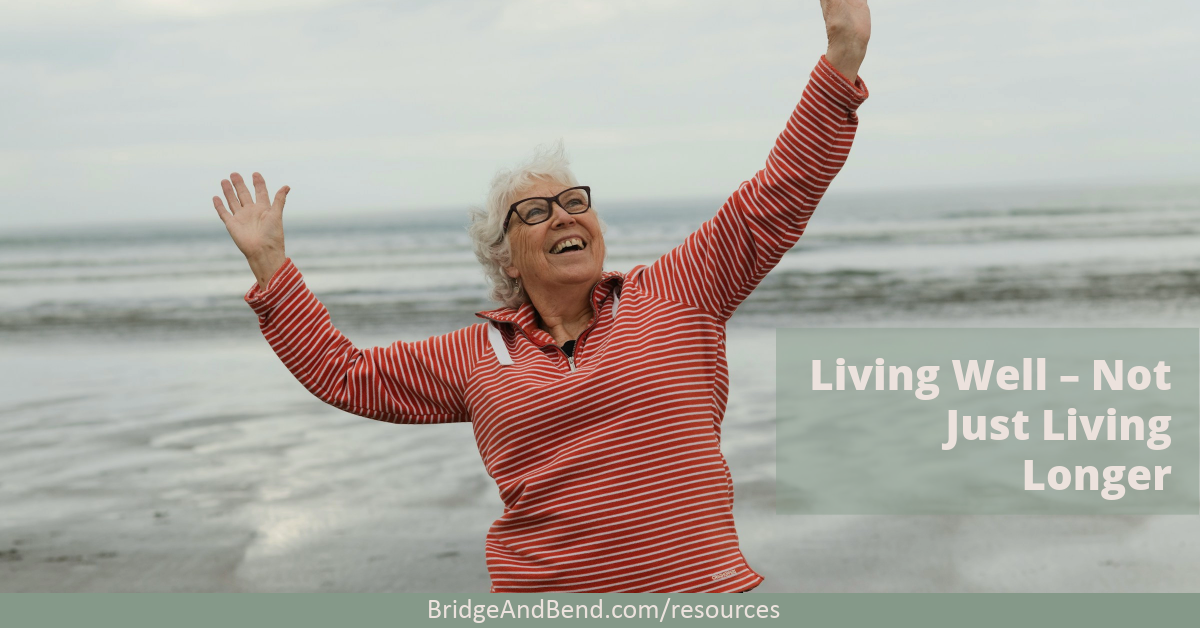
“I’m not training for my summer body.
I’m training for my old lady body.”
If your algorithm is anything like mine, you’ve probably seen this quote floating around online lately.
It’s often followed by variations like:
• I’m doing squats now so I can get out of a chair in my 80s.
• I’m lifting weights now so I can pick up my grandkids one day.
It’s catchy. A little humorous. But it actually captures something very important.
Because the choices we make today – how we move, how we eat, how we rest, how we manage stress – quietly shape the life we will be living decades from now.
This idea fits directly into my overall movement and health philosophy that I’m taking you through in this series on building capacity for life.
In this post, I want to introduce two concepts that help us think differently about our health:
- Healthcare vs sick-care
- Lifespan vs healthspan
Both challenge us to rethink how we care for our bodies – and what we are really aiming for as we age.
Let’s get into it…
Healthcare vs Sick Care
(Reactive medicine vs proactive health habits)
My definition: Sick-care focuses on treating disease after it appears, while healthcare focuses on caring for the body in ways that prevent disease and support long-term wellbeing.
Most of us interact with the medical system when something goes wrong.
We go to the doctor when we have a cold.
We go to the physiotherapist when we have pain.
Basically… we seek help when something feels broken.
In many ways, what we call healthcare is actually closer to sick-care.
It’s a system designed to treat disease once it appears – a reactive response to illness, injury, and pain.
And of course, that care is incredibly important. Modern medicine can do extraordinary things when illness or injury occurs.
But if we only think about our health once symptoms appear, we miss a much bigger opportunity.
True healthcare starts long before we are sick.
You might see this in everyday life:
Someone develops back pain, sees a physiotherapist, gets better…and then goes back to the same lifestyle that created the problem in the first place.
Nothing about their overall health capacity has changed.
So the next flare-up arrives a few months later – and the cycle repeats.
Sick-care fixes the problem in the moment.
Healthcare asks a different question:
What needs to change so the body becomes more resilient in the long run?
The Missing Link: Building Health Before Disease Appears
Shifting our mindset from sick-care to healthcare impacts how we experience our life now – and well into the future.
The direct link lies in how daily choices and lifestyle behaviours affect our long-term physiology.
It’s about caring for the systems of the body in ways that support resilience and wellbeing over time.
That means paying attention to the everyday things that shape our health:
- Movement
- Nutrition
- Sleep and rest
- Stress management
- Social connection and community
- Mental and emotional wellbeing
These are not small lifestyle choices on the side of life.
They are the foundations of health.
When we start thinking about healthcare instead of sick care, we shift from reacting to problems to actively building the health that supports long-term wellbeing.
Not only how long we live – but how well we live.
Lifespan vs Healthspan
The second idea I’d like to challenge you on is the difference between lifespan and healthspan.
Lifespan simply refers to how long we live.
And in many parts of the world, lifespan is increasing. People are living longer than ever before.
But the more important question is this:
How well are we living during those extra years?
Because for many people, the later decades of life can come with a heavy burden of health challenges:
- Cognitive decline
- Frailty and weakness
- Low bone density
- Metabolic disease
- Loss of independence
- Needing assisted living support
And the sad reality is that the longer people live with chronic conditions, the more likely they are to have significant impact and disability. In other words, people may live longer – but not necessarily better.
This is where the idea of healthspan becomes important.
My Definition: Healthspan is the portion of life that we spend healthy, active, and able to live independently.
It’s the years where we can:
- Move freely
- Stay mentally engaged
- Remain involved in our communities
- Enjoy meaningful activities
- Maintain independence
The goal isn’t simply living longer.
The goal is living well for longer.
Daily Healthcare to Build Healthspan
(Building Capacity for Life)
So how do these ideas connect? I can get pretty fired up about this 🤣
It’s literally where I live in my practice as a physio on a daily basis.
The encouraging news is that many of the things that influence healthspan are within our control.
I’m not going to delve deeply into all the lifestyle aspects right now, but let’s take a quick overview of some important ones.
They are closely connected to the same foundations we spoke about earlier.
Movement and Strength
Maintaining muscle mass and strength helps protect against frailty, falls, and loss of independence.
It also plays a powerful role in supporting metabolic health.
Diet and Metabolic Health
Supporting metabolic wellbeing helps reduce the risk of conditions like type 2 diabetes and cardiovascular disease.
The earlier these conditions develop, the longer the body lives with them – and the greater the likelihood of complications.
Cognitive Engagement
Keeping our minds active through learning, problem-solving, and social engagement supports long-term brain health.
Stress and Nervous System Health
Chronic stress affects many systems in the body, including inflammation, metabolism, and mental wellbeing.
Community and Connection
Humans are social beings. Strong relationships are consistently linked to better health outcomes and longer lives.
These factors work together to influence not just how long we live, but how well we live.
And they all shape the way the body constantly adapts to the load and the life it is given.
But real, lasting change happens when supportive behaviours become part of identity – not just something we do when things go wrong.
Biology explains change.
Identity sustains change.
This is why I so often speak about the importance of holding an identity like “I am an active person.”
Because when that identity is in place, choices and behaviours that support healthcare and healthspan naturally flow from it.
The Takeaway: A Small Reframe That Changes Everything
The shift is actually quite simple:
Sick-care → Healthcare
Focus on caring for your health before problems appear.
Lifespan → Healthspan
Focus not just on living longer, but living well for longer.
When we make this perspective shift we stop asking:
How do I fix problems once they appear?
And begin asking:
How do I care for my body in a way that supports a long, active, meaningful life?
This is the essence of building capacity for life.
The bridge between true healthcare and healthspan is in the daily choices that we make.
How we move.
How we rest.
How we eat.
How we manage stress.
How we stay connected to the people around us.
These everyday behaviours quietly shape the future health of our bodies.
It’s about investing in the strength, resilience, and health of your body now so that future-you has more freedom, more independence, and more possibility.
So maybe that viral quote really does get it right.
Not because we should all be worried about getting older.
But because it’s a helpful reminder that the body we live in later in life is being built right now.
The strength you build today.
The habits you create today.
The way you care for your health today.
All of it quietly shapes the decades ahead.
If you’re interested in learning more about how lifestyle, movement, and physiology influence long-term health, subscribe to follow along with this series.
Next week we’ll explore another fascinating piece of the puzzle:
Aging, inactivity, and “inflammaging” – and how chronic low-grade inflammation influences the aging process.
🤍 Carmen
Further Resources
Read more about Building Capacity for Life:
📃 Why Information Isn’t Enough (and What Actually Creates Change)
🥔 The Potato Bag Principle: How Bodies (and Habits) Actually Get Stronger
🧠 The Mind-Body Connection: Why How You Think Affects How You Move
🧘♀️ Why Mindful Presence in the Body Matters for How You Move
🧪 Why Injuries Happen: Physiology Before Structure
Disclaimer: Our content is for general information only and isn’t a substitute for medical or health advice. Reading or using this content doesn’t create a practitioner-client relationship. Please speak to your healthcare provider before making changes to your health, movement, or wellness routine. Read our full disclaimer here.