
🎬Video player not displaying? Watch it here.
When it comes to exercise, one of the very first tips people tend to give us is to get an exercise buddy. Today, we’re going to explore why. We’ll look at some of the benefits of exercising with someone, some surprising and some a little more obvious, and then at some ways to work around it if you don’t have somebody you can train with on a regular basis.
9 Benefits of Exercising With a Buddy
1. Accountability
This is the obvious one, and it’s probably genuinely one of the strongest reasons to train with an exercise partner. If you’ve committed to someone, you’re more likely to show up, because you’re there to support them.
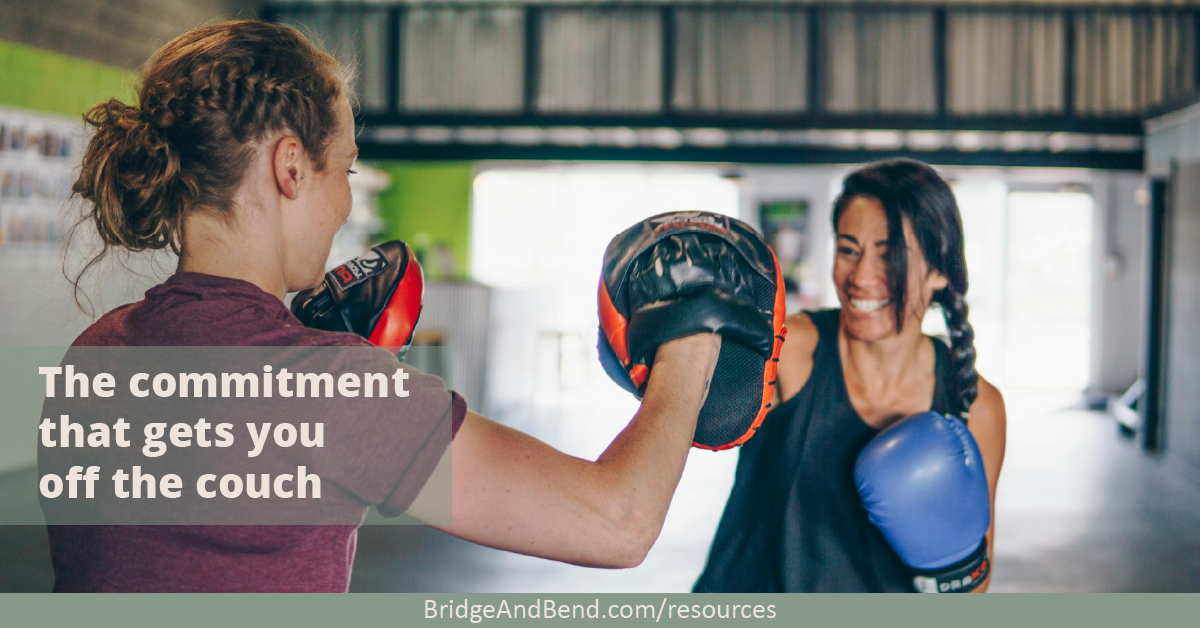
Think about it this way. If I’m really tired after a long week, doing something for myself…whether that’s journaling, preparing for the week ahead, or even something fun like cooking a great meal for friends…is going to have a hard time getting me off the couch while I’m watching TV. But if I’ve made a commitment to a friend to go for a walk or a coffee, it’s a foregone conclusion that I’ll get up and go and meet that person, because it’s a commitment to them that’s outside myself. Training with a workout buddy does exactly the same thing.
2. Commitment and planning
If you’re going to train with someone, you quite often have not only a training plan, so you know what you want to do, but also a time. You’ve already put that workout, with that particular person, into your diary. So when it comes up, you don’t have to decide when you’re going to go or what you’re going to do. It’s already there.
Even if you don’t have a fixed plan for the kind of training you’ll do, there’s a little less decision overwhelm because two people are making that decision together. Making the plan ahead of time boosts your commitment, and you’re taking advantage of pre-planning.
3. Motivation and mental resilience
When you do something hard with someone, it builds a shared sense of camaraderie. It turns stress into shared accomplishment, and it makes it feel more manageable to carry on doing hard things.
4. Competition and encouragement
Somewhat similar to number three: when you train with someone, you’re more likely to train at a higher intensity and push yourself slightly further, out of a sense of friendly competition…or just by helping each other stay present and work a little harder. You’ll get better outcomes from each session, and doing that repeatedly over time accumulates into better fitness and better performance.
5. Safety and form feedback
I’ve grouped these together because I they’re overlapping ideas. Safety can mean what you’re doing within the workout itself. If something goes wrong or you injure yourself, there’s someone there to help you. But it can also mean that having someone with you makes what you’re doing safer. Two women walking together on the road is typically a lot safer than one woman walking on her own. If you’re going rock climbing, it could be quite reckless to do that on your own, but doing it with a partner makes it much safer. (And yes, I refer to us mere mortals who are not record challenging free-climbers 😉)
Take that into the gym. If you’re weightlifting, you have someone to see what you’re doing and give feedback on your form, to spot for you, to pick up weights for you, and generally to ease the flow of your workout. You do that for each other, building further camaraderie and making it safe and enjoyable for you both.
6. Routine, variety and efficiency
We tend to get stuck in our own ruts. We do the same thing over and over. We do the thing we’re particularly good at, or the thing we really enjoy, and we don’t push ourselves or explore new things.
When you train with someone else, you’re with a person who has different strengths, different goals perhaps (or you might share goals), different knowledge, and different things they enjoy doing. Together you can introduce each other to different aspects of exercise. One person can program one workout and the other the next, or you can choose a planned progression of workouts to do together. That introduces you to different types of exercise and helps round out your movement skills, strength, health and flexibility.
7. Connection and co-regulation
These two are so closely tied together that I couldn’t separate them. When you spend time with a person, your nervous systems talk to each other. That can help settle and calm you both. If one of you is struggling to get energised and motivated, the other person’s energy can bring you up, bring you present, and help you get going through the workout. If you’ve had a bad day, it helps settle you back in. And just being around people is great for us in general.
You could even make this co-regulation your primary benefit. If you’re struggling to come back to a regulated point, if you’re very stressed, overwhelmed or grieving, regularly meeting up with somebody and using that connection to co-regulate can be a really helpful way of restoring balance in your nervous system. Movement is also really beneficial for nervous system regulation, so pairing the two builds on each aspect of it.
8. Temptation bundling
This is a slightly nerdy one. The term comes from work originally done by Katy Milkman, who looked at how regularly people exercised, and whether they kept to their declared exercise intention, if they paired what she termed a temptation with the exercise. In the study, audio novels were stored on a device that was kept at the gym, so people only had access to the audiobook while they were working out. They used something they wanted to do, listening to the book, to encourage the behaviour of regular exercise, and it turned out to be really effective.
So if you have a friend you love to see and love to catch up with, but it’s hard to fit into your life, or you tend to prioritise seeing a person over exercise, this is a really nice way to bring the two together. You almost gate seeing your friend in the week to exercise: in order to see them, you need to meet up to work out. And obviously you can see them for fun at other times, too.
9. Fun and enjoyment
Training with someone can be an absolute blast. You can do silly things and laugh together. You can share the toughness, the encouragement, and the achievement of outcomes. It really takes movement to a whole other level when it becomes something fun, something you look forward to.
It’s not necessarily the most scientific of lists, but they are all really useful reasons why training with an exercise partner can be so helpful.
How to Find an Exercise Buddy (It Doesn’t Have to Be One Person)
If you struggle to get to the gym regularly, try to work out who in your life you could invite to exercise with you. It doesn’t have to be the same person all week. You could plan different things with different people: a park run with someone on a Saturday, a Pilates class with someone midday during the week, or a walk with somebody after you drop the kids off at school. Look at how you could build it into your life to make exercise easier.
No Exercise Buddy? 5 Ways to Get the Same Benefits
If you genuinely can’t find an exercise accountability partner, here are some other ways to use these tips to get yourself out exercising more regularly.
Take the relationship virtual
Have somebody you check in with every time you work out to say, “I did a workout today,” and they do the same for you. Instead of training together, you’re virtual accountability partners. It could be your partner or a friend, it doesn’t really matter, but it’s a nice way to keep yourself on track by telling someone what you’ve achieved.
Plan it and calendar it
Take advantage of the commitment and planning aspect. Pick a specific workout program, decide when you want to do it, and put it in your calendar. It decreases the effort of having to make a decision each time, and when it’s already in your calendar, it’s much easier to slip into the thing that’s planned than to try to fit it in after the fact.
Compete against yourself
Track your results. That could be progressing from one level of a Pilates workout to another, say from beginner to intermediate. It could be increasing the weight you train with as you get stronger, walking faster over 5 km, or building up from walking 2 km to 3 km. Track your results over time and see if you can better your previous results from a month or two ago.
Follow a structured plan
Pick a workout plan that will teach you a new movement skill or build you up towards a particular goal. Finding an online plan is quite easy. If you’re interested in building Pilates basics, my four-week program, Body Renewal & Core Connection, is a great option, but there are so many options out there that you’ll easily find something that suits where you are now and what your goals are. By gradually progressing through a plan, you build skill, you build strength, and you learn new things, and there’s motivation and progression baked into the plan.
Use temptation bundling on your own
Pick a particular audiobook or podcast that you only allow yourself to listen to while you’re out for a walk or at the gym. I once heard a person talking about how they liked what they termed trash TV, watching The Bachelor, but they only let themselves watch it if they were on a stationary bike. You could also meet someone for coffee only after you’ve been to a yoga class. There are many ways to do it, so find something that suits your life and your goals, and tie something you particularly enjoy to your exercise almost as a gating mechanism.
What I Do
If I’m entirely hones…I use a combination of both 💪 I have a friend I train with midweek. We meet at a trainer and do a session together, which is a regular event, and we push each other over time. It’s an enjoyable part of my week. I also have friends I meet for walks, and I use temptation bundling too: I listen to particular podcasts when I’m doing workouts at home on my own in the morning.
So read back through this post, or listen to the video again, and jot down two or three things that might encourage you to find an accountability partner, or that you can plug into an existing relationship to make it a little more beneficial, and to make getting fitter, healthier and stronger something you enjoy even more.
🤍 Carmen
Resources & references
📃 Article on temptation bundling – Holding the Hunger Games Hostage at the Gym: An Evaluation of Temptation Bundling (Milkman et all 2014)
🌻 Wired for Connection: Understanding Co-Regulation and Nervous System Health
🚶 Get Situated for Movement: 4 Ways to Make Exercise Easier to Keep Up
🧘♀️ Exercise program introducing Pilates: Body Renewal & Core Connection
Disclaimer: Our content is for general information only and isn’t a substitute for medical or health advice. Reading or using this content doesn’t create a practitioner-client relationship. Please speak to your healthcare provider before making changes to your health, movement, or wellness routine. Read our full disclaimer here.